Your partner picks up a diamond-shaped, head-heavy frame and starts hitting cleaner bandeja shots than they have ever managed. You try the same racket in the next session and your arm is dead by the third game. Same court, same brand, same model. Completely different experience.
This happens constantly in padel, and it makes sense once you understand what is actually going on. Padel is a doubles sport where your court position, physical profile, and natural playing style diverge from your partner's in ways that directly affect which frame works for you. Borrowing someone else's racket choice, no matter how much you trust their opinion, skips the one variable that matters most: your game.
Shape is not just aesthetics#
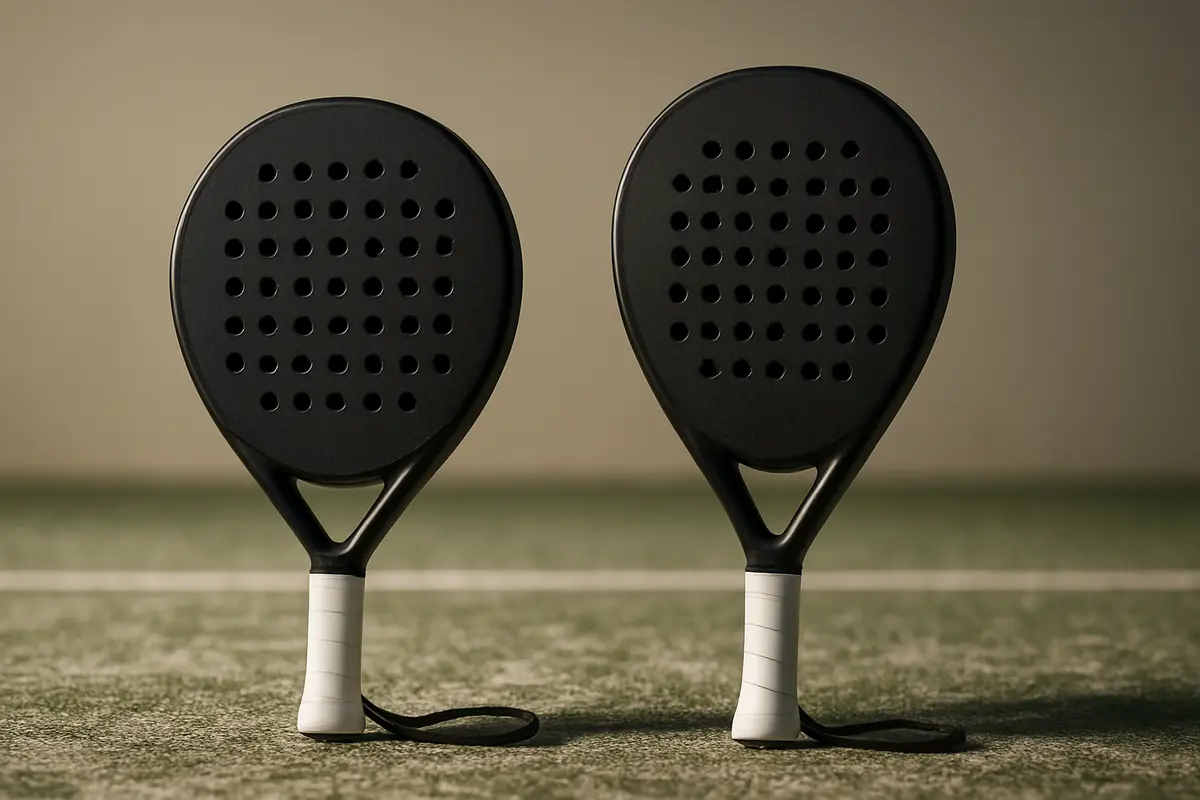
The three main padel racket shapes (round, teardrop, and diamond) place the sweet spot in different parts of the hitting surface. A round frame concentrates the sweet spot low and central, which rewards consistent contact and suits players who rely on touch, angles, and controlled volleys at the net. A diamond shape pushes the sweet spot high, towards the head, generating more power on overhead smashes and aggressive shots from the back court.
If you play predominantly at the net and your partner anchors the back, you are hitting fundamentally different shots under different time pressure. A diamond frame that helps them load up on a powerful smash gives you less margin on a reflex volley where you need feel, not force. The teardrop sits between the two and is often where I point players who are still working out their position preference, but even that is not a universal answer.
Identify where you spend most of your time on court before you look at shape. If you are genuinely split between net and back, lean round or teardrop and err towards control.
Balance changes everything about how a racket feels in motion#
Balance point is described as low (handle-heavy), medium, or high (head-heavy). This is where I see the most mismatched buying decisions between doubles partners.
A head-heavy frame amplifies swing speed into power, but it also increases the rotational load on your wrist and elbow during fast exchanges. If you have a long, smooth swing and reasonable arm strength, that is manageable. If you play with a compact, reactive technique, or if you have any history of elbow discomfort, a head-heavy frame will punish you within a few sessions. Your partner with the longer swing and no injury history may never notice the difference.
Weight compounds this. Two players can both pick up a 365g frame and have completely different experiences based on their grip strength, swing mechanics, and how long they have been playing. I have handed the same frame to a 6ft 2in former tennis player and a 5ft 4in player returning to sport after a few years off, and they might as well have been holding different objects.
Handle-heavy or low-balance frames demand more from your swing to generate pace, but they are far more forgiving on the arm and give you better control on touch shots. For players who are building consistency rather than hunting power, that trade-off is worth it every time.
Stiffness is the variable people forget to ask about#
Padel rackets vary in how much the frame flexes on contact. Stiffer frames (typically full carbon construction) transfer energy efficiently and feel crisp, but they also transmit more vibration into your arm. Softer frames (fibreglass face, or a mix of materials) absorb more impact and feel more forgiving.
Here is a simple way to think about it:
| Your profile | Frame stiffness to consider |
|---|---|
| Strong swing, plays 4+ times a week, no arm issues | Stiffer frame, full carbon |
| Developing technique, plays 1-2 times a week | Medium flex, mixed materials |
| History of tennis elbow or wrist problems | Softer frame, fibreglass or EVA-heavy construction |
| Transition from tennis, strong arm but new to padel | Medium flex to start, reassess after 3 months |
| Experienced player prioritising net control | Medium to soft, round or teardrop shape |
| Power-focused back court player with no injury history | Stiffer, diamond or teardrop, head-heavy balance |
Your partner's profile almost certainly sits in a different row to yours. That is the whole point.
How to think about your own game before you buy#
Before you look at a single listing, spend ten minutes being honest about three things.
First, your court position. Where do you actually play, not where you aspire to play? If you are a back court player who occasionally comes forward, buy for the back court. If you are a net player who gets pushed back under pressure, buy for the net. Your racket should suit your current game, not the version of your game you are working towards.
Second, your physical profile. How long have you been playing? Do you have any arm or shoulder history? How strong is your grip? Lighter frames and softer constructions are not a compromise for weaker players. They are the correct choice for a wide range of players who do not need, and cannot efficiently use, a stiff, head-heavy frame.
Third, your technique. A compact, punchy swing style and a long, looping swing put the frame through completely different demands. If your technique is still developing, a more forgiving frame will let you build consistency without fighting the gear. If you have a repeatable, confident swing, a stiffer frame will reward it.
If you are still finding your feet in padel, the guide to choosing your first padel racket covers the fundamentals in more detail, and it is worth reading before you commit to anything.
Pre-owned frames are a smart way to test the fit#
One of the best arguments for buying pre-owned is that it lowers the cost of getting it wrong. If you spend full retail on a frame because your partner swears by it and it turns out to be completely wrong for your game, that is an expensive lesson. If you spend a fraction of that on a pre-owned frame in good condition, try it for a month, and discover it is not right, you have lost very little and learned a lot.
The inverse is also true. If you find a pre-owned frame that fits your game perfectly, you have saved money on gear that is functionally identical to the same model new. The perforated hitting surface of a padel racket does not degrade the way tennis strings do. A well-maintained frame from a year ago plays the same as it did when it left the factory.
Browsing pre-owned padel rackets by shape and weight range is a much better starting point than filtering by brand. Once you know whether you want a round, low-balance frame or a diamond, head-heavy one, the brand becomes secondary. There are excellent frames from multiple manufacturers in each category, and many of them are available pre-owned at prices that make experimentation genuinely affordable.
If you are thinking about selling a frame that no longer suits your game, these tips on listing your gear will help you write a description that finds the right buyer quickly.
The frame your partner loves is not a recommendation. It is data about their game. Use it as a starting point for understanding what suits yours.