Most players string their racket at whatever the previous one was strung at, or pick a number in the middle of the recommended range and call it done. I have done both. It took me an embarrassing number of restrings to realise I was fighting my own gear every time I played.
String tension is one of the few genuinely adjustable variables in your setup. Your frame is fixed, your grip size is fixed, but tension can be dialled in every time you restring. Getting it right will not transform your game overnight, but getting it wrong will quietly cost you: extra errors, a tired shoulder, shots that feel dead when you catch them off-centre. If you are buying a pre-owned racket, there is an extra layer here too, because the string job you inherit tells you almost nothing useful about the frame underneath it. More on that shortly.
What tension actually does to the ball#
The physics is straightforward once you stop thinking about it backwards. A tighter string bed deflects less when the ball lands on it. That means the ball spends less time in contact with the strings, which means less energy transfer and a lower launch speed. Higher tension equals less power, more control. Lower tension equals a more elastic string bed, more dwell time, more power, and a larger effective sweet spot.
The reason players associate high tension with control is not wrong exactly. It is just incomplete. A tighter string bed gives you a crisper, more predictable response, which feels like control when you are hitting cleanly. But if you are a club player who does not generate pace through your own swing, stringing tight means you are working against the racket to get the ball deep. The control you gain is theoretical. The pace you lose is real.
A practical starting point: if you are a baseline grinder who generates your own pace and wants precision on flat drives, sit in the upper third of the recommended range. If you are working on topspin, developing your game, or playing more than three times a week, start in the middle or lower third. Your arm will thank you too. Lower tension absorbs more shock on off-centre hits, which matters over a long season.
Why the factory recommendation is a starting point#
Every frame ships with a recommended tension range printed on the throat or the inside of the head. Something like 50-60 lbs (23-27 kg). That range is set by the manufacturer based on structural testing. String above it and you risk warping the frame over time. String below it and the string bed goes slack enough to affect how the frame performs. Within that window, though, the choice is entirely yours.
The range is not a prescription. It does not account for your swing speed, your playing style, the climate you play in, or the string type you are using. A polyester string at 55 lbs plays very differently from a natural gut at 55 lbs, even in the same frame. Poly is stiffer, so it plays tighter than the tension number suggests. Most players who switch to poly for the first time and string it at their usual tension find it feels boardy and dead. The standard advice is to drop 2-4 lbs when moving to poly, and I would go to the higher end of that drop if you play on hard courts or have any history of arm issues.
Climate matters more than most players account for. String tension drops in cold weather and rises in heat. If you play outdoors in winter, a string job that felt perfect in September will feel noticeably looser by November. Some players string tighter going into winter for exactly this reason.
Matching tension to playing style and string type#
Here is how I think about it in practical terms:
| Player type | String type | Suggested range | Notes |
|---|---|---|---|
| Baseline, high swing speed | Polyester | Lower third of recommended | Poly already plays stiff; no need to add tension |
| Baseline, moderate swing speed | Polyester | Middle of recommended | Going too low loses feel on touch shots |
| All-court, arm-conscious | Multifilament or hybrid | Middle to upper third | Softer string absorbs shock; tension can go higher without discomfort |
| Net player, touch-focused | Natural gut or multifilament | Upper third | More feel and feedback at the net; gut stays arm-friendly even at higher tension |
| Beginner or developing player | Synthetic gut or multifilament | Lower to middle | Forgiveness and power assist while technique develops |
| Cold-weather / outdoor player | Any | Add 2-3 lbs to usual tension | Compensates for tension drop in low temperatures |
One thing that table cannot capture: how a string feels after it has been in the frame for a while. Poly loses tension faster than any other string type, sometimes 10% in the first few hours of play. If you are stringing poly and playing regularly, restringing every 30-40 hours of play is not obsessive, it is just maintenance. Multifilament and natural gut hold tension longer and tend to break before they play dead, which is actually easier to manage.
Buying pre-owned: judge the frame, not the string job#
This is the part that trips up a lot of players who are new to buying pre-owned gear. You pick up a racket that looks great, take it out for a hit, and it feels wrong. Too stiff, too lively, no feel. Before you write off the frame, check when it was last strung and with what.
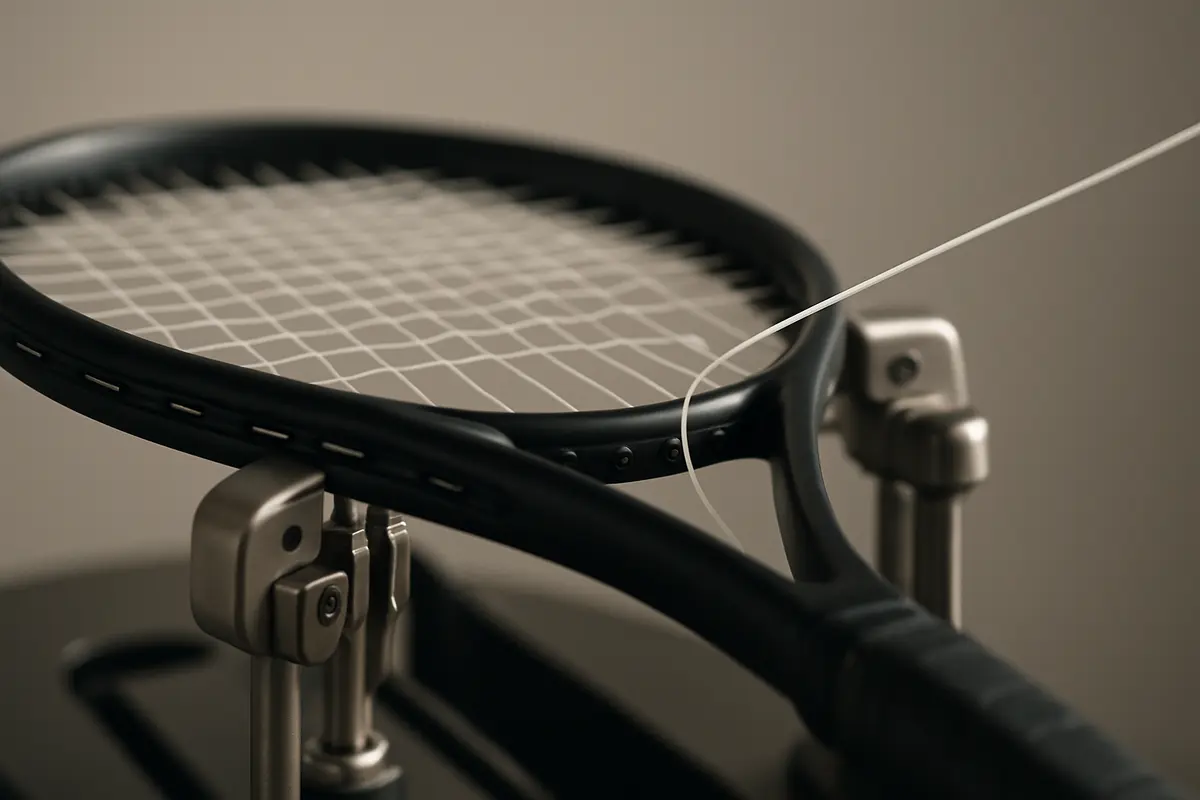
A poly string job that is six months old and has been sitting in a bag is not telling you anything meaningful about the frame. It is telling you that poly loses tension over time and should have been replaced before the racket was listed. When I buy a pre-owned frame, I factor in the cost of a fresh restring from the start. It is usually £15-25 depending on the string, and it means I am actually evaluating the frame rather than the decayed string job.
If you are browsing pre-owned tennis rackets and a listing does not mention when the frame was last strung, ask. A seller who has looked after their gear will know. If they do not, budget for a restring and choose a string type that suits your style rather than defaulting to whatever was in there before.
The pre-owned market is full of good frames that have been sitting unplayed because someone upgraded or changed their game. Those frames deserve a fresh string job and a fair assessment, not a snap judgement based on a dead string bed.
For more on evaluating frames before you buy, the post on how to spot a fake tennis racket covers what to look for in person and from photos. And if you are thinking about what surface you play on most and how that should influence your whole setup, clay vs hard court gear goes into the full picture.
Where to go from here#
Pick a tension in the lower half of your frame's recommended range if you have been stringing in the middle or top and your arm has ever felt it. Try it for a full restring cycle before judging it. If you switch string types at the same time, adjust for the string's stiffness, not just the tension number.
If you are shopping for a frame to try this with, the pre-owned market is the sensible place to start. You can pick up a frame you would not risk buying new, restring it to your spec, and find out whether it actually suits your game before committing. That is not a compromise. That is a smarter way to buy gear.