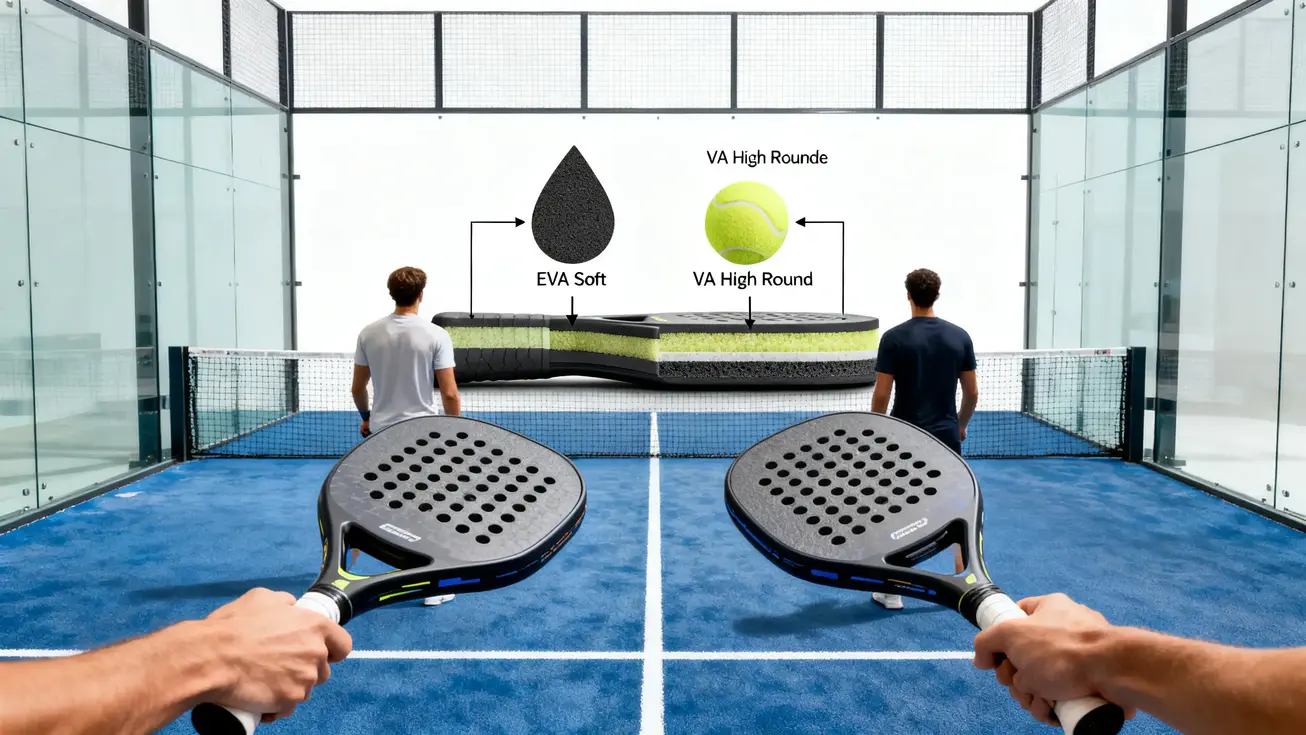
Pick up two padel rackets that look almost identical on the outside and one will feel like hitting through a mattress, the other like smacking a wall. The face material gets most of the attention in reviews, but the foam core underneath it is doing the majority of the work. If you are shopping for a pre-owned racket and you are not asking about the core, you are missing the most important question.
As a player, this matters because the core is also the part that degrades fastest. A carbon-fibre face stays carbon fibre for years. The foam inside compresses, hardens, and loses its character over thousands of impacts. Knowing what you are buying, and what condition it is likely to be in, is the difference between a smart purchase and an expensive mistake.
What EVA foam actually is#
EVA stands for ethylene-vinyl acetate. It is a closed-cell foam used in everything from running shoe midsoles to surf mats, and it has been the dominant padel core material for the better part of two decades. The closed-cell structure means it absorbs impact and then returns to shape, which is exactly what you want in a racket that has to perform consistently across a long match.
The key variable is density. Manufacturers tune the density of EVA foam to change how the racket feels at the moment of contact. Everything else, the shape of the frame, the thickness of the face, the weight distribution, works on top of that fundamental density decision.
EVA soft: control, feel, and who it suits#
EVA soft is lower-density foam. When the ball hits the face, the core compresses more before it pushes back. That extra give translates into a longer dwell time, the fraction of a second the ball stays in contact with the racket surface. Longer dwell time means more feel and, in practice, more control over where the ball goes.
I have hit with EVA soft rackets at every level and the sensation is consistent: the ball feels like it is sticking to the racket for just a moment. Volleys are easier to place, touch shots at the net feel precise, and off-centre hits are more forgiving because the foam absorbs some of the misdirection rather than sending it straight into your wrist.
The trade-off is power. Softer foam gives back less energy on hard strikes. If your game is built around attacking from the back, you will notice the difference. EVA soft also tends to degrade faster in pre-owned rackets because the foam compresses permanently over time. A soft core that has seen two seasons of regular play may feel noticeably deader than it did new.
Who it suits: players at beginner to intermediate level, anyone who prioritises control and touch, players with arm or elbow sensitivity, and those who play defensively or in the net game.
EVA high round: power, pace, and the trade-off#
EVA high round (sometimes listed as EVA HR or hard round by retailers) is higher-density foam. It compresses less on impact and returns energy faster. The result is a livelier, more powerful response, particularly on flat, attacking shots from mid-court and the back.
The "round" in the name refers to the shape profile most associated with this core type, a round or teardrop frame that places more weight and hitting surface in the upper half. The foam density and the frame shape are separate things, but manufacturers pair them so consistently that the two terms have become almost synonymous in casual conversation. Worth separating them in your head when you are reading listings.
EVA high round rackets reward players who have already built consistent technique. Because the core is less forgiving, off-centre hits transmit more vibration and the ball goes where your swing sends it rather than where you wanted it to go. At the right level, that directness is exactly what you want. At the wrong level, it punishes you on every imperfect contact.
EVA high round cores hold up better over time than soft cores. The higher density means there is less room for the foam to compress permanently. A pre-owned racket with a hard core that has been well maintained is a genuinely good buy.
Who it suits: intermediate to advanced players, those with an attacking game, players who generate their own pace and want the racket to amplify it, and anyone who has already ruled out arm issues.
Core comparison at a glance#
| EVA soft | EVA high round | |
|---|---|---|
| Foam density | Lower | Higher |
| Feel on contact | Soft, cushioned | Firm, direct |
| Dwell time | Longer | Shorter |
| Control | Higher | Lower |
| Power | Lower | Higher |
| Vibration on off-centre hits | Dampened | More pronounced |
| Typical frame shape pairing | Diamond, round | Round, teardrop |
| Degradation rate | Faster | Slower |
| Good pre-owned buy if | Lightly played, recent season | Well maintained, any age |
Hybrid cores exist and are worth mentioning. Some manufacturers layer soft EVA at the centre of the hitting zone and denser EVA around the perimeter, trying to combine the touch of a soft core with the stability of a hard one. Babolat and Head have both used versions of this in mid-range frames. In my experience the results are genuinely good for intermediate players who want one racket that does most things reasonably well, but they do not fully replicate either end of the spectrum.
What to check when buying pre-owned#
Core condition is invisible from the outside, which is why you need to ask the right questions. Here is what I look for and what I ask sellers.
Ask about age and play frequency. A soft-core racket played three times a week for two years is likely to feel noticeably compressed. The same racket played once a week for two years may still have plenty of life. Sellers who know their gear will tell you this directly.
Press the face gently with your thumb. A healthy soft core has a small amount of give. A dead core feels like pressing on wood. This is not a precise test but it is a reliable sanity check you can do before handing over money.
Check the perforations. The holes in the hitting surface should be clean and circular. Deformed or cracked perforations around the sweet spot indicate heavy use and often correlate with a compressed core underneath.
Look at the frame edges. Chips and dents on the frame edge suggest the racket has been dropped or hit against walls regularly. That kind of impact accelerates core compression, particularly at the edges where the foam meets the frame.
Ask if it has been repalmed or reglued. Some players and shops re-seal the frame after the core starts to separate. It is not necessarily a problem, but it tells you the racket has had a harder life.
If a seller cannot answer basic questions about how the racket has been used, that is information too.
For a broader look at what to check before buying any pre-owned racket, the post on how to spot a fake tennis racket covers authentication principles that transfer directly to padel gear. And if you are still deciding whether padel is the right sport to invest in, padel vs tennis fitness might help you think it through.
Where to go from here#
If you know your level and your game style, the core choice is straightforward. Soft core if you are building your game and want feel. Hard core if you are attacking and generating your own power. Hybrid if you genuinely want the middle ground rather than just settling for it.
The pre-owned market has good options at every level. Browse the padel rackets currently listed on the marketplace and filter by condition. When you find one you like, ask the seller about the core. A seller who knows the answer is a seller worth buying from.