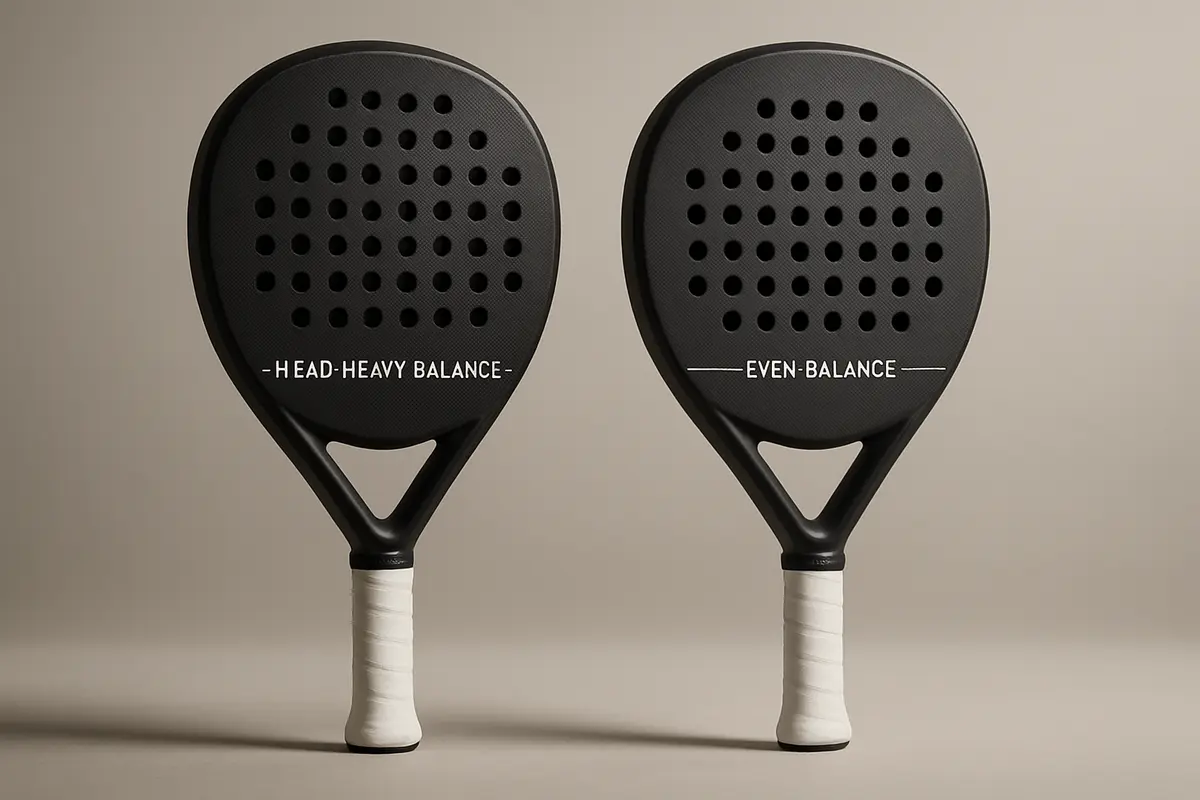
Pick up a head-heavy padel racket and then pick up an even-balance one. They might weigh within five grams of each other, yet one will feel like a weapon and the other like a wand. That difference is not marketing. It is physics, and once you understand it you will stop buying frames that fight your game.
Because padel rackets have no strings, weight and balance are essentially the only two variables that change how a frame feels in your hand. String tension is a lever you can adjust on a tennis racket; on a padel racket the EVA foam core and the carbon or fibreglass face are fixed from the factory. You cannot retune them. That makes the buying decision more consequential, not less, and it is why so many players end up with a garage full of frames that almost worked. Understanding what the numbers mean before you buy, or before you list a frame you have outgrown, is the fastest way to stop wasting money on gear that does not suit you.
What the weight bands actually mean#
Most padel rackets land between 350 g and 390 g unstrung (there are no strings, but the convention of quoting frame weight alone still holds). That 40 g window sounds small. In a sport where you might swing a racket 200 times in a single match, it is not.
Frames below 360 g are generally aimed at beginners, juniors, or players coming back from elbow or shoulder problems. They are easier to swing fast and produce less fatigue over a long session, but they give up some punchthrough on hard smashes. The 360-375 g band is where most intermediate players live. It is broad enough to cover a lot of different shapes and balance points, which is exactly why balance matters so much within it. Frames above 375 g start to reward players with good technique and physical conditioning. The extra mass amplifies power when you time the ball well, and punishes you when you do not.
One practical note: manufacturers sometimes quote weight with the grip and overgrip already fitted. Check whether the figure you are reading is the bare frame or the ready-to-play weight. A 10 g overgrip changes the feel less than it changes the balance, because the added mass sits at the handle end.
Head-heavy balance: what you gain and what you pay for it#
A head-heavy racket has its centre of mass above the midpoint of the frame, typically 265 mm or more from the butt of the handle. That high balance point acts like a pendulum weight. When you swing, the head wants to keep moving, which translates into more power on volleys and smashes without you needing to generate all of it from your shoulder.
I have hit with several frames in the 270-280 mm balance range and the difference at the back of the court is real. Bandeja shots carry further. Smashes feel more authoritative. If you play a lot of attacking padel from the baseline or you are a bigger player who can manage the extra load, a head-heavy frame rewards you.
The cost is arm load and manoeuvrability. A high balance point increases the effective swing weight, which is the resistance you feel when accelerating the racket. Over a two-hour match that accumulates. Players with a history of tennis elbow should be cautious here. At the net, where padel points are often won and lost, a head-heavy frame is slower to redirect. Reaction volleys feel slightly sluggish compared to an even-balance racket of the same weight.
Even and low balance: control and speed at the net#
An even-balance racket sits with its centre of mass around 250-260 mm from the butt, sometimes lower. The weight is distributed more uniformly across the frame, or biased slightly toward the handle. The result is a lower swing weight, faster wrist movement, and a racket that goes where you point it with less effort.
At the net this is a significant advantage. When the ball comes at you quickly and you have half a second to redirect it, you want a frame that responds to small adjustments in your wrist and forearm rather than one that carries its own momentum. I find even-balance frames noticeably more forgiving on tight angle volleys and on the quick exchanges that decide points at the net.
The trade-off is that you generate more of the power yourself. On a smash from the back, an even-balance frame does not give you the same free momentum that a head-heavy one does. If you are a net-oriented player who relies on placement and touch rather than pace, that is an acceptable trade. If you are trying to finish points with power from deep, it is not.
Choosing by playing style: a quick reference#
| Player type | Recommended weight | Recommended balance | Why |
|---|---|---|---|
| Beginner or returning player | 350-365 g | Even (250-260 mm) | Easier to control, less arm fatigue |
| Net-dominant intermediate | 360-375 g | Even to slight head-light | Fast redirection, touch volleys |
| All-court intermediate | 365-375 g | Even (255-265 mm) | Balanced between power and control |
| Attacking / back-court player | 370-385 g | Head-heavy (265-280 mm) | Power on smashes and bandeja |
| Advanced with strong technique | 375-390 g | Head-heavy | Full benefit of swing weight |
| Player with elbow sensitivity | 355-370 g | Even or head-light | Reduces torque on the arm |
Balance figures are measured from the butt end. Most manufacturers publish this number; if they do not, you can measure it yourself by balancing the frame on a pencil and measuring from the end of the handle to the balance point.
How to use this when buying pre-owned#
Pre-owned padel rackets are genuinely good value precisely because the frame does not degrade the way strings do. A carbon face that has been well looked after plays the same as it did on day one. What you are buying is the geometry: weight, balance, shape, and core hardness. All of those are fixed and knowable before you commit.
When you are browsing padel rackets on the marketplace, filter by frame condition and then look at the spec sheet before you look at the price. A 380 g head-heavy frame at a good price is still the wrong buy if you are a net player who needs something around 365 g with an even balance. Getting that decision right on a pre-owned frame saves you real money compared to buying new and discovering the mismatch after two weeks.
If you are listing a frame you have moved on from, weight and balance are the two numbers worth putting in your description. Players searching for a specific feel will find your listing faster, and you will get fewer questions from buyers who later discover it does not suit them. There is more on writing a useful listing in how to sell your rackets effectively.
For players who are newer to the sport and still working out what shape and balance suits them, choosing your first padel racket covers the broader decision including shape and core hardness alongside balance.
The short version: if you play mostly from the back and want power, go heavier and head-heavy. If you live at the net and value speed and control, go lighter and even-balance. Either way, buy the spec first and the brand second.