A pre-owned padel racket listed at a fair price can be a genuinely smart buy. The same racket with a delaminated face can be a waste of money and, in an edge case, a safety risk. The difference is usually visible or feelable if you know what to look for, and most buyers never bother to look.
If you are picking up a frame at a club swap, browsing padel rackets on a marketplace, or just wondering whether your own racket is still worth playing with, this guide will walk you through every check that matters. I have inspected a lot of frames over the years behind the shop counter, and the defects that cause real problems are almost always findable before money changes hands.
Why the face is the first thing to check#
A padel racket is not a tennis racket. There are no strings. The hitting surface is the face itself: a layer of carbon fibre or fibreglass bonded onto an EVA foam core, perforated with holes that affect feel and air resistance. The structural integrity of that bond is everything. When the bond fails, the face separates from the core, the sweet spot migrates or disappears, and the energy transfer on contact becomes inconsistent. You hit the same shot you have hit a thousand times and it goes somewhere unexpected.
Beyond performance, a badly delaminated face can fracture on a hard smash. Carbon splinters are not something you want near your face or a playing partner's. This is not a common failure, but it is a real one, and it is entirely avoidable if you inspect before you buy.
The four defects that actually matter#
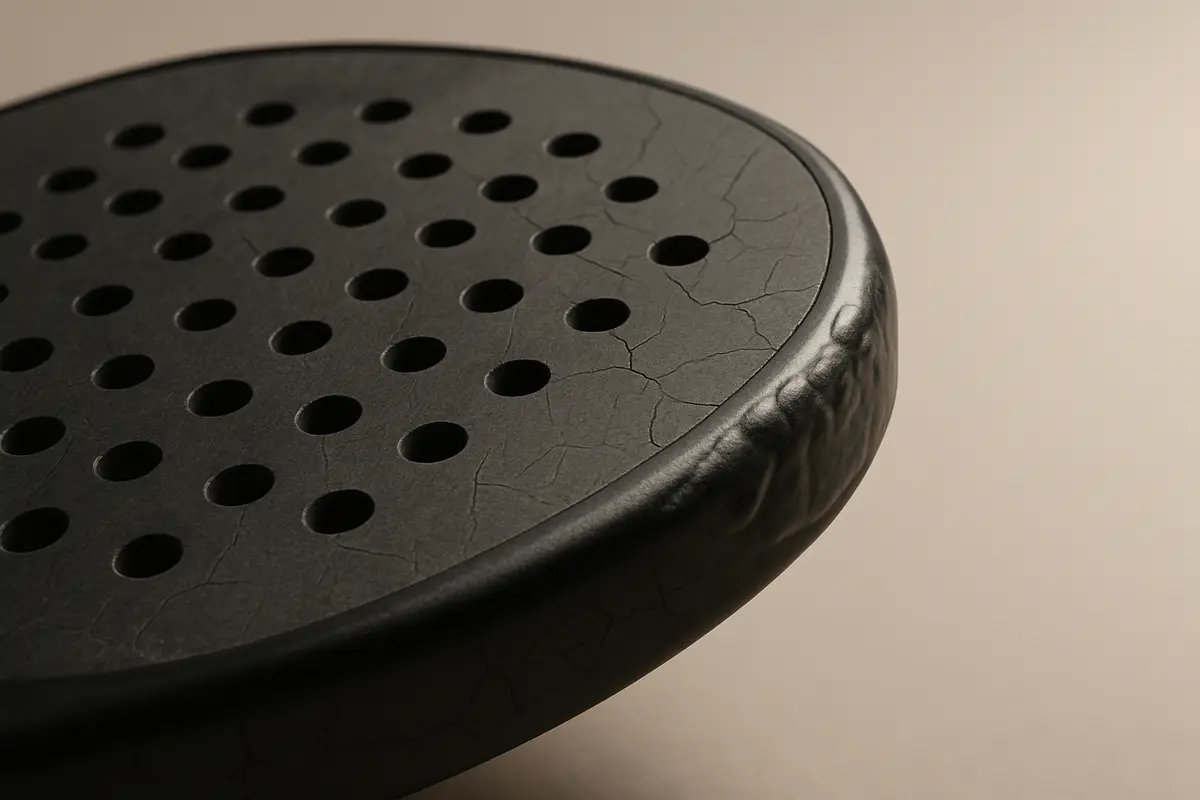
Hairline cracks in the face. These are the easiest to miss and among the most serious. Hold the racket at an angle to a bright light source and rotate it slowly. You are looking for fine lines that catch the light differently from the rest of the surface. On a carbon face they often appear as slightly lighter or darker threads running across the weave. On a fibreglass face they show as white stress lines. Pay particular attention to the area around the holes, where the material is thinnest, and to the upper third of the face where smash impact concentrates. A single hairline crack near the centre of the face means the frame is structurally compromised. A crack near the edge guard is slightly less critical but still worth factoring into the price.
Delamination bubbles and soft spots. Press the face firmly with your thumb, moving systematically across the surface in a grid pattern. A healthy face feels uniformly solid. A delaminated area feels softer, sometimes springy, and in advanced cases you can hear a faint hollow knock when you tap it with a knuckle, compared to the dull thud of a sound face. Visually, delamination often shows as a raised or bubbling area, especially in carbon faces where the weave pattern looks slightly lifted or irregular. Soft spots near the sweet spot will noticeably change how the racket plays. Soft spots near the edge are less immediately catastrophic but indicate a frame that is continuing to fail.
Edge guard damage and frame separation. The plastic edge guard protects the join between the face layers and the core. Chips and cracks in the edge guard are cosmetic if they are shallow. If you can see daylight between the edge guard and the face, or if the guard flexes away from the frame when you press it, moisture has almost certainly entered the core. EVA foam that has absorbed water loses its damping properties and the frame becomes unpredictably lively or dead depending on temperature. This is not recoverable. A separated edge guard on an otherwise clean-looking racket is a reason to walk away or negotiate hard.
Impact dents versus structural damage. Padel frames take knocks off walls, floors, and other rackets. Most of what you see on a pre-owned frame is cosmetic: paint chips, surface scuffs, shallow marks in the face coating. These do not affect play. The test is whether the underlying material is intact. Run your fingernail across a scuff. If it catches on a ridge, you are feeling a surface scratch. If your nail drops into a depression and the area around it feels soft, the face material has been breached and you need to assess depth. A dent that has gone through the face layer into the foam core is a structural issue.
Inspection checklist: what to do before you buy or list#
| Check | How to do it | Pass | Fail |
|---|---|---|---|
| Hairline cracks | Angle to bright light, rotate slowly | No lines visible in face material | Any crack crossing the weave or running from a hole |
| Soft spots | Thumb pressure across full face in grid | Uniform firmness throughout | Any area that compresses differently or springs back |
| Hollow sound | Knuckle tap across face | Consistent dull thud | Any hollow or papery knock |
| Edge guard bond | Press guard inward along full perimeter | No flex, no visible gap | Guard lifts, gap visible, or guard is cracked through |
| Face-to-core separation | Inspect face edge at guard join | Face flush with guard | Visible layering, gap, or raised edge |
| Cosmetic scuffs | Fingernail across marks | Nail slides over, no depression | Nail catches, area feels soft underneath |
| Hole integrity | Look at each hole edge | Clean, sharp edges | Cracks radiating from hole edges |
Print this or screenshot it. It takes three minutes to run through on any frame.
How to factor damage into a pre-owned decision#
A racket with purely cosmetic marks is worth close to its clean equivalent. I would not discount more than five to ten percent for surface scuffs on an otherwise sound frame. Once structural damage enters the picture, the calculus changes completely.
A soft spot away from the sweet spot, with no cracking, on a frame that is otherwise solid: I would play with it and price it accordingly, with full disclosure in the listing. A hairline crack anywhere on the face: I would not buy it for regular play, and I would not list it without making the crack explicitly visible in photos and describing it in the listing text. A separated edge guard with suspected moisture ingress: the frame is at end of life for competitive play. It might be fine as a loaner or a beginner's first hit, but it should be priced and described as such.
If you are selling, honest description is not just ethical, it is practical. A buyer who receives a frame that matches its listing has no reason to complain. A buyer who finds a crack that was not mentioned will leave a negative review and ask for a refund. The tips on selling pre-owned rackets cover this in more detail, but the short version is: photograph defects in good light, describe them plainly, and price them in.
If you are buying, ask for additional photos of anything that looks ambiguous. A seller who is confident in their frame will send them. A seller who goes quiet or deflects is telling you something.
Before you go#
The pre-owned market for padel gear has grown quickly, and most of what is listed is genuinely sound. The frames that cause problems are the ones that nobody looked at carefully. Spend three minutes with this checklist and you will catch almost everything that matters.
If you are in the market right now, the padel rackets section of the marketplace lets you filter by condition, and listings from sellers who have included close-up face photos are worth prioritising. If you are new to padel and still working out what frame suits you, the guide to choosing a first padel racket is a good place to start before you commit to anything.
Good gear should be in play. Knowing what you are actually buying is how you make sure it stays there.