You are browsing pre-owned tennis rackets and you cannot demo any of them. The listing shows a weight, a head size, and a beam width. Most players skip straight past that last number. I think that is a mistake, because beam width is one of the fastest ways to understand how a frame will feel before you ever pick it up.
If you buy pre-owned regularly, you already know the problem: you are committing money to a frame based on a spec sheet and a few photos. The more you can read from those numbers, the fewer expensive surprises you get. Beam width will not tell you everything, but it narrows the field quickly, and once you understand what it signals about stiffness and power, it becomes a reliable first filter when you are scrolling through tennis rackets in the marketplace.
What beam width actually is#
The beam is the cross-sectional thickness of the racket frame, measured in millimetres at the widest point. Most manufacturers quote it at the throat, the widest part of the head, or both, which is why you sometimes see a figure like 23/26/23 mm on a spec sheet. That three-number sequence describes the beam at the throat, at the widest point of the hoop, and at the top of the head respectively. A single number means the beam is consistent throughout, which is common on traditional players' frames.
A higher number means a thicker frame, and a lower number means a thinner one. Where it gets interesting is what that thickness does to the physics of the frame.
How beam width connects to stiffness and power#
A thicker beam resists bending. When the ball makes contact with the strings, a stiffer frame deflects less, which means more of the energy from that collision goes back into the ball rather than being absorbed by the frame. The result is more power for the same swing speed. Wide-beam frames, roughly 26 mm and above, are built around this principle. They suit players who take shorter, more compact swings and need the frame to generate pace they cannot produce themselves.
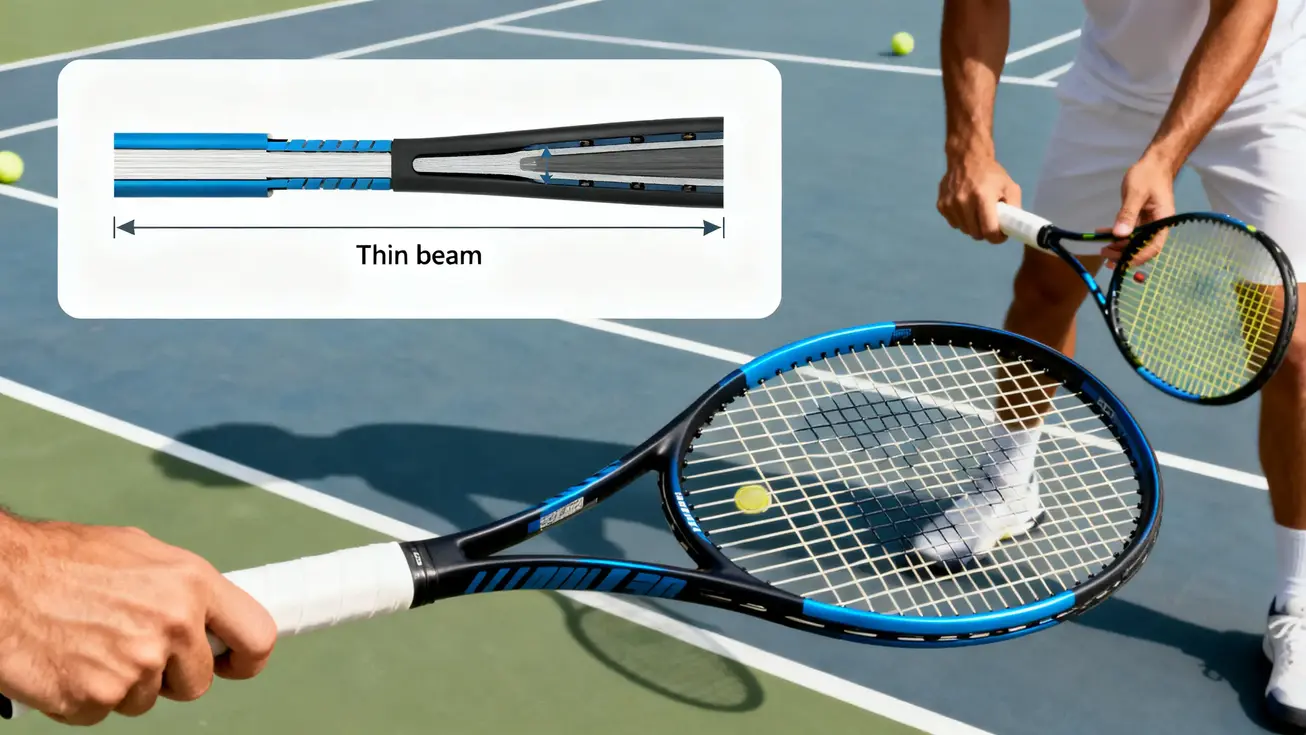
A thin beam, typically 22 mm and below, flexes more on impact. That flex absorbs some energy, which reduces power but increases dwell time: the brief moment the ball sits on the strings. More dwell time gives you more feel, more feedback about where on the face you struck the ball, and more ability to shape shots. This is why almost every frame marketed at advanced and professional players has a thin beam. The player supplies the power; the frame supplies the feedback.
If a listing shows a beam width above 26 mm, expect a power-oriented frame. Below 22 mm, expect a control-oriented frame that rewards a full swing. The 22 to 26 mm range is genuinely transitional, and you need to look at other specs, particularly stiffness rating and head size, to understand where it sits.
Beam profile: constant versus variable#
A constant beam runs the same width all the way around the hoop. Variable beam frames taper or widen at different points, and that shaping changes where the frame is stiff and where it gives a little. A frame that is wider at the top of the hoop and narrower at the throat will feel more powerful on high contact points and slightly more forgiving on low ones. Manufacturers use variable profiles to blend characteristics that a single number cannot capture.
This matters when you are reading a listing. A frame quoted as 23/26/23 is not the same as one quoted as 26 mm flat, even if the middle number matches. The variable-beam frame will feel more controlled at the throat where you mishit, and livelier in the upper hoop where you make clean contact. When a listing only shows one number, it is worth checking the manufacturer's original spec page to see whether the frame is truly constant or whether the seller has just quoted the peak measurement.
Beam width as a buying filter: a quick reference#
Use this as your starting point when reading spec sheets on pre-owned listings. These are generalisations, and individual frames vary, but they hold up well as a first pass.
| Beam width | Typical character | Best suited to |
|---|---|---|
| Under 20 mm | Very flexible, maximum feel, low power | Advanced players with fast, full swings |
| 20 to 22 mm | Controlled flex, excellent feedback | Intermediate to advanced, all-court game |
| 23 to 25 mm | Moderate stiffness, balanced feel and power | Intermediate players, transitional frames |
| 26 to 28 mm | Stiff, power-oriented, reduced feel | Club players, shorter swings, beginners moving up |
| 29 mm and above | Maximum stiffness, arm-friendly power | Beginners, players returning after injury |
One thing this table does not show: a stiffer frame transmits more vibration to the arm. If you have had elbow or wrist issues, a wide beam without a dampening system in the handle can aggravate them. It is worth cross-referencing beam width with the stiffness rating (RA score) if the listing includes it, or looking it up. A frame can be wide-beam but still have a moderate RA if the layup uses more fibreglass than carbon. Do not assume wide automatically means harsh.
Using beam width when you cannot demo the frame#
The specific challenge with pre-owned is that you are making a decision without any tactile information. Here is how I use beam width as part of a quick mental checklist before I decide whether to enquire about a listing.
First, I check whether the beam width matches the type of player the frame was designed for. If a listing describes a "players' frame" but shows a 28 mm beam, something is off. Either the description is wrong or the seller has misidentified the frame. That is worth a question before you buy. For more on spotting inconsistencies in listings, the post on how to spot a fake tennis racket covers the kinds of spec mismatches that should make you pause.
Second, I match beam width against my own game. I hit with a lot of topspin and a reasonably fast swing, so anything above 25 mm tends to feel like it is working against me rather than with me. If you are still building your swing and you need the frame to help you generate pace, a wider beam is the right tool.
Third, I look at whether the beam width is consistent with the head size and unstrung weight. A 100 sq in head with a 19 mm beam and 290 g unstrung is a very specific kind of frame: demanding, precise, built for someone who already knows what they want. A 105 sq in head with a 28 mm beam and 265 g unstrung is the opposite end of the spectrum. Both can be excellent value pre-owned. They are just excellent for completely different players.
If you are newer to reading specs this way, the clay vs hard court gear post is worth a read alongside this one, because surface affects how much you want your frame to do for you in terms of power, and that feeds back into which beam width makes sense for your regular game.
The best pre-owned deals go to players who know exactly what they are looking for. Beam width takes about three seconds to check, and it will rule out half the listings before you spend any more time on them. Browse the current tennis rackets in the marketplace and try running the filter in your head as you go. You will find it sticks quickly.