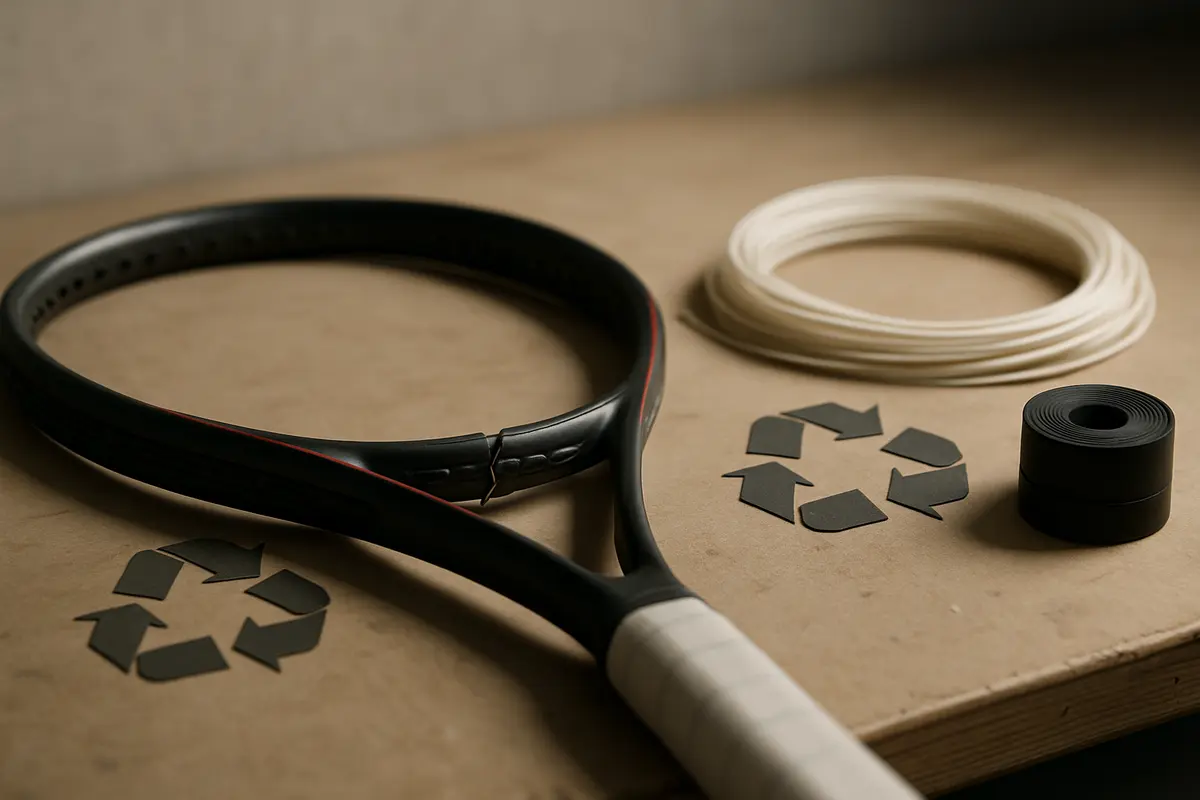
Your frame feels a bit tired. The grip is shiny, there is a cracked grommet near the throat, and someone at the club mentioned a hairline mark on the head. The instinct is to browse new frames. Before you do, it is worth knowing that manufacturing a single graphite racket generates somewhere between 10 and 20 kg of CO2 equivalent, depending on where it is made and how it is shipped. A set of replacement grommets costs under five pounds and takes a stringer twenty minutes to fit.
That gap between the cost of repair and the cost of replacement is where most of the environmental case lives. Extending a frame's useful life by even one year means one fewer frame manufactured, packaged, and eventually landfilled. Carbon fibre and fibreglass composites do not biodegrade in any meaningful timeframe. The frame you throw away today will still be recognisable in a landfill in 2125. That is not a scare figure, it is just material science. So the question worth asking before every purchase is not "do I want something new?" but "is this frame actually finished?"
What a stringer or workshop can realistically fix#
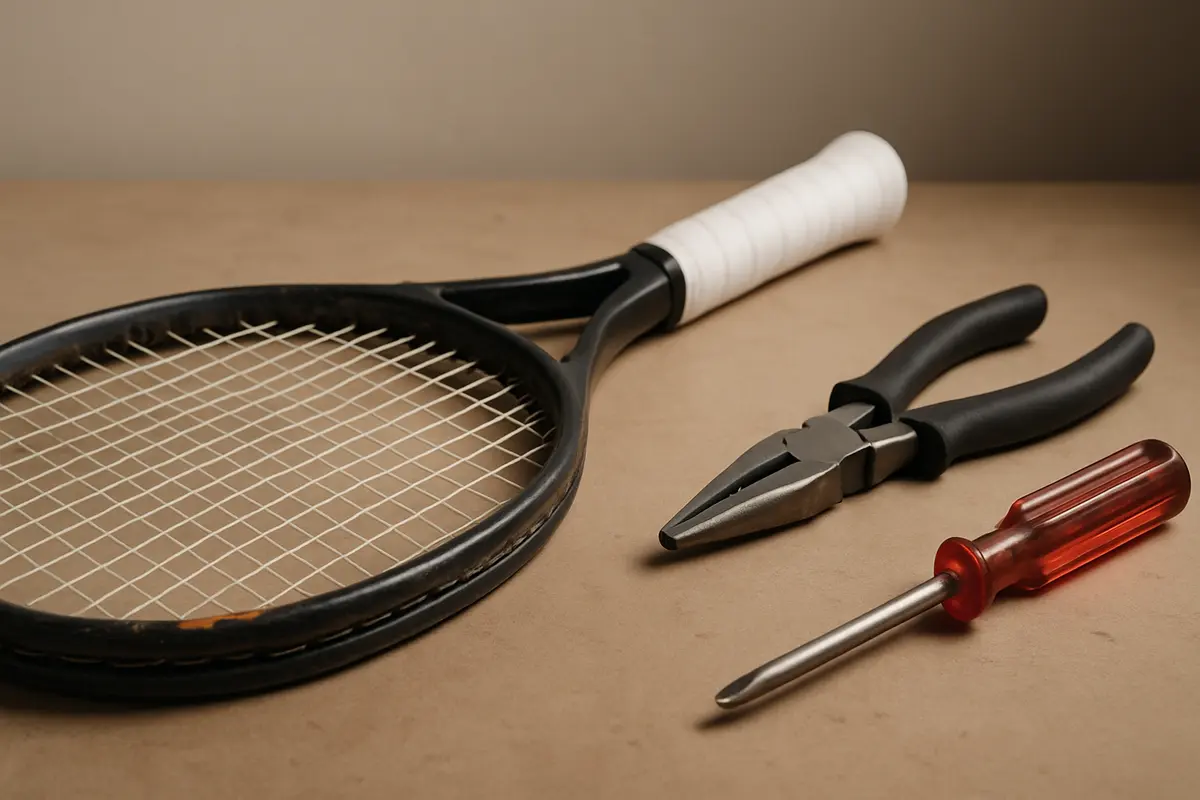
A good local stringer does more than string. I have had grommets replaced, bumper guards swapped, and a cracked throat piece assessed at the same counter where I drop off my frames to be strung. Here is what is genuinely within scope for most workshops.
Grommets and grommet strips. These are the plastic tubes that protect strings from the frame's sharp edges. They wear through, crack, and occasionally pop out entirely. Left alone, they allow strings to cut against bare graphite, which shortens string life and can introduce stress points in the frame. Replacement strips are cheap and widely stocked. If your frame is a common model, a stringer will have the part or can order it within a few days.
Bumper guards. The plastic strip around the top of the frame takes the worst of any scraping along hard or clay courts. It is sacrificial by design. Replacing it is straightforward on most frames, though some modern designs integrate the bumper more tightly with the grommet strip, which makes the job slightly fiddlier. Still entirely worth doing before concluding the frame is worn out.
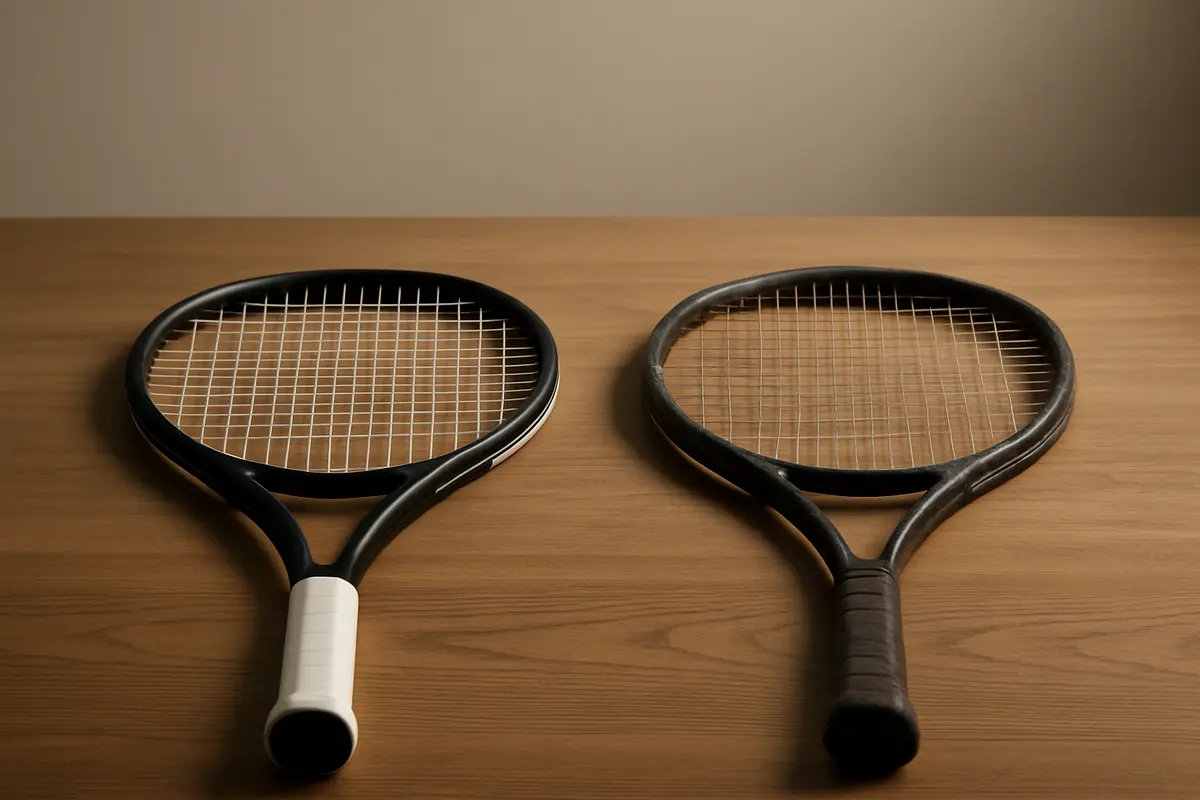
Grip and overgrip. A shiny, compressed grip changes how the racket feels in your hand and, more importantly, how securely you hold it. Replacing the base grip entirely (not just adding an overgrip on top of a dead one) costs a few pounds and transforms how the frame plays. I have picked up pre-owned frames that felt lifeless, replaced the grip, and found the racket underneath was in excellent condition.
String and tension. For tennis frames, a fresh string job at the right tension can make a frame that has been sitting unstrung for months feel completely different. Strings lose tension even without play. If you have not restrung in over a year, do that before you decide the frame is past it.
If your frame's problems are all at the periphery (grip, grommets, bumper, strings) then the frame itself is almost certainly fine. You are looking at a repair bill of ten to thirty pounds, not a replacement.
What a professional crack assessment actually tells you#
A crack is not automatically a death sentence for a frame, but it does require an honest look from someone who knows what they are examining. I would not ask a retail assistant. I would ask a stringer or coach who has seen a lot of frames fail.
Hairline marks in the paint are common and almost always cosmetic. Graphite frames flex under load and the paint does not always flex with them. Run a fingernail across the mark. If it catches, if there is any depth to it, treat it as a structural crack until proven otherwise.
Structural cracks in the frame material itself are a different matter. A crack at the throat, where two pieces of the frame join, or anywhere in the hoop where the string bed puts the frame under tension during play, is serious. A cracked frame can fail suddenly and the head can move in ways that are genuinely dangerous. No repair is appropriate here. The frame is finished.
Cracks in the handle or at the handle-throat junction are worth a second opinion. Some can be stabilised. Most cannot be made safe for regular play.
Get a proper assessment before you decide. Do not assume a mark is structural, and do not assume it is cosmetic. Ten minutes with someone experienced will tell you which category you are in.
The numbers behind one extra year of use#
The carbon cost of a new graphite racket sits in the manufacturing and materials phase. Once the frame exists, the ongoing footprint of playing with it is negligible. Strings, grips, overgrips: these are small items. The big number is already spent when the frame leaves the factory.
This means that extending a frame's life has a disproportionate effect on its lifetime carbon footprint per year of use. A frame used for two years has roughly half the annual footprint of the same frame used for one year. A frame used for five years has one fifth. The maths is simple but the implication is real: keeping a frame in play is one of the most effective things a player can do to reduce the environmental cost of their gear.
Here is a rough comparison to make that concrete.
| Scenario | Estimated CO2e | Notes |
|---|---|---|
| Buy new frame, use 1 year | 15 kg | Manufacturing plus disposal |
| Buy new frame, use 3 years | 5 kg per year | Same manufacturing cost, spread further |
| Repair grommets and grip, use 1 more year | Under 0.5 kg | Materials and labour only |
| Buy quality pre-owned frame, use 3 years | 2 to 3 kg per year | Manufacturing already accounted for |
The pre-owned figure is lower because the manufacturing carbon is shared across the frame's full life, including the time it spent with its previous owner. This is the same logic behind the second-hand gear sustainability case: buying pre-owned is cheaper and materially better for the environment, because you are not triggering a new manufacturing cycle.
When to let a frame go (and what to do with it)#
Some frames are genuinely finished. Structural cracks, severe delamination where the layers of the composite are separating, or a frame so old that replacement parts no longer exist: these are real endpoints. Holding onto a frame that is unsafe to play with is not sustainable, it is just sentiment.
When a frame reaches this point, the right move is to remove it from the playing cycle rather than pass it on as playable. That might mean keeping it as a display piece, using it for demonstration purposes, or checking whether your local recycling facility has a composites stream (rare, but increasingly available in some areas).
For frames that are worn but structurally sound, the marketplace is the right answer. A frame that feels dated to you may be exactly what a beginner or an intermediate player is looking for, especially if it is a quality make that is no longer in production. Listing it rather than binning it keeps the frame in play and offsets someone else's need to buy new. If you are not sure how to price or present a pre-owned frame, the tips on selling pre-owned rackets post covers the practical side.
If you are on the buying side and want to avoid the new-frame carbon cost entirely, browsing tennis rackets or padel rackets on the marketplace is the obvious starting point. Frames listed there have already been assessed by their owners and are priced to move.
The honest summary is this: most frames that players consider replacing are not actually worn out. They need a grip, some grommets, a string job, and someone to look at that mark on the hoop and confirm it is paint. That is a thirty-pound afternoon, not a hundred-and-fifty-pound decision. The environment aside, it is also just better value. Quality frames deserve a longer life than we usually give them.