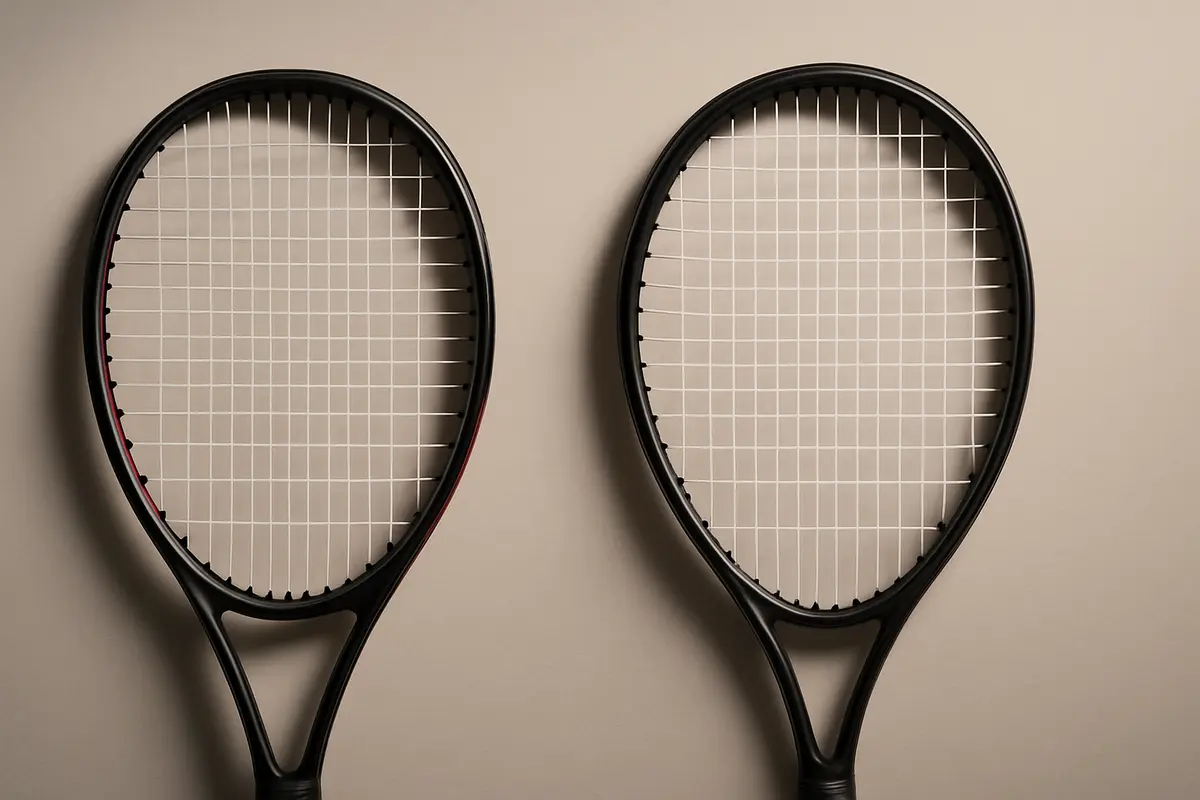
I have handed a lot of players a pre-owned frame that felt almost right and watched them put it back on the shelf because of a vague complaint: too stiff, too light, strings dying too fast. Nine times out of ten, a few pounds of accessories would have fixed it. The frame was fine. The setup was not.
If you have recently bought or are considering a pre-owned tennis racket, or if you just want to squeeze more out of what you already play with, understanding what dampeners, lead tape and string savers actually do at a physical level is worth ten minutes of your time. None of this is magic, but none of it is placebo either, when used correctly.
Vibration dampeners: what they do and what they do not#
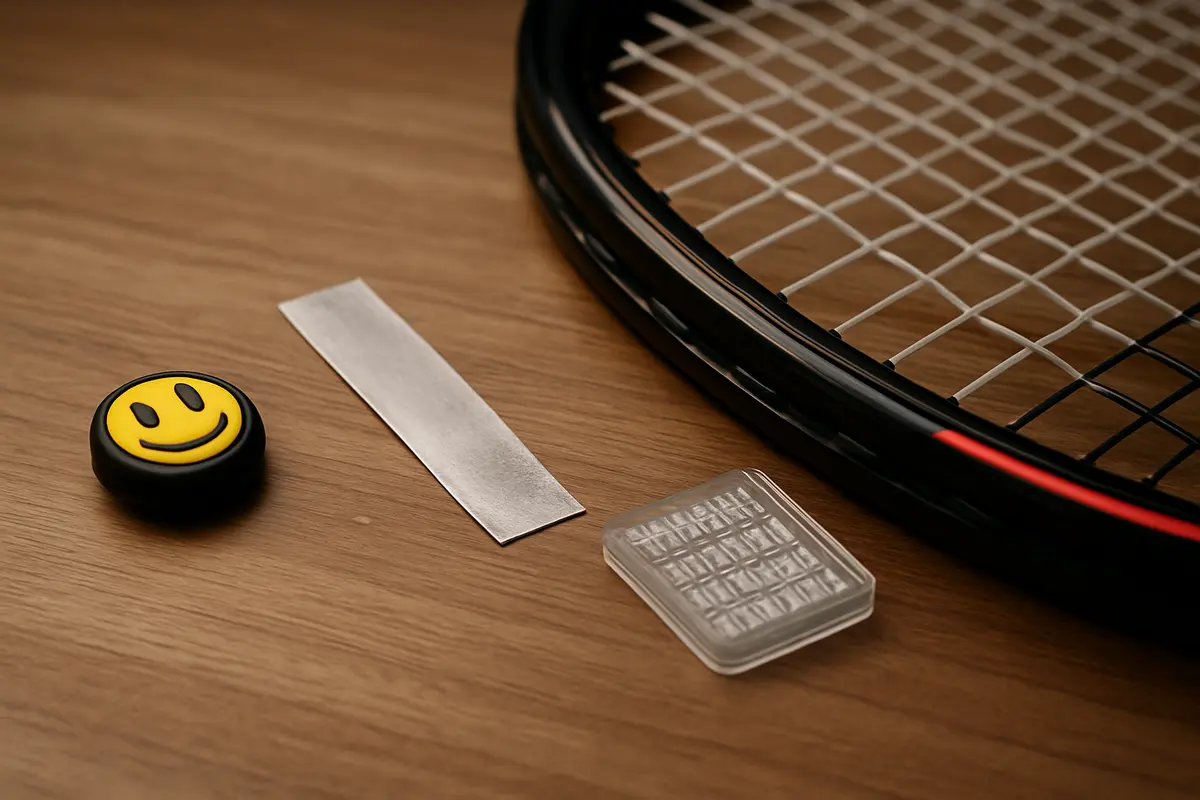
A dampener sits in the string bed, typically between the two central main strings just below the throat, and its job is to change the frequency at which the strings vibrate after contact. That is it. It does not reduce the shock that travels through the frame and into your arm. Biomechanics research is consistent on this point: the force transmitted to the wrist and elbow is largely unaffected by a small rubber dampener.
What it does change is the sound and the feel of the string bed. Without one, strings ring at a higher pitch and the feedback through the handle feels crisper, sometimes described as "pingy". With one, the vibration damps out faster and the feel is more muted. Whether that is better is entirely personal. I play without one on my main frame because I like the feedback, but I use one on a stiffer backup because the muted feel makes long sessions more comfortable.
Placement matters more than most players realise. A standard button dampener goes between the two central mains below the bottom cross. A worm or strip dampener can span several strings and damps more aggressively. The further into the string bed you move a dampener (some players thread them higher up), the more it affects feel, but most manufacturers design them for the standard throat position.
Buy a dampener to change feel and sound, not to protect your arm. If you have arm trouble, look at string type, tension and frame stiffness first. Our tennis string tension guide covers that ground properly.
Lead tape: the most underrated tool in the bag#
Lead tape is thin, adhesive-backed strips of lead that you apply to the frame itself. It adds weight, and where you put it determines what changes. This is the accessory with the most genuine effect on how a racket plays, and it costs almost nothing.
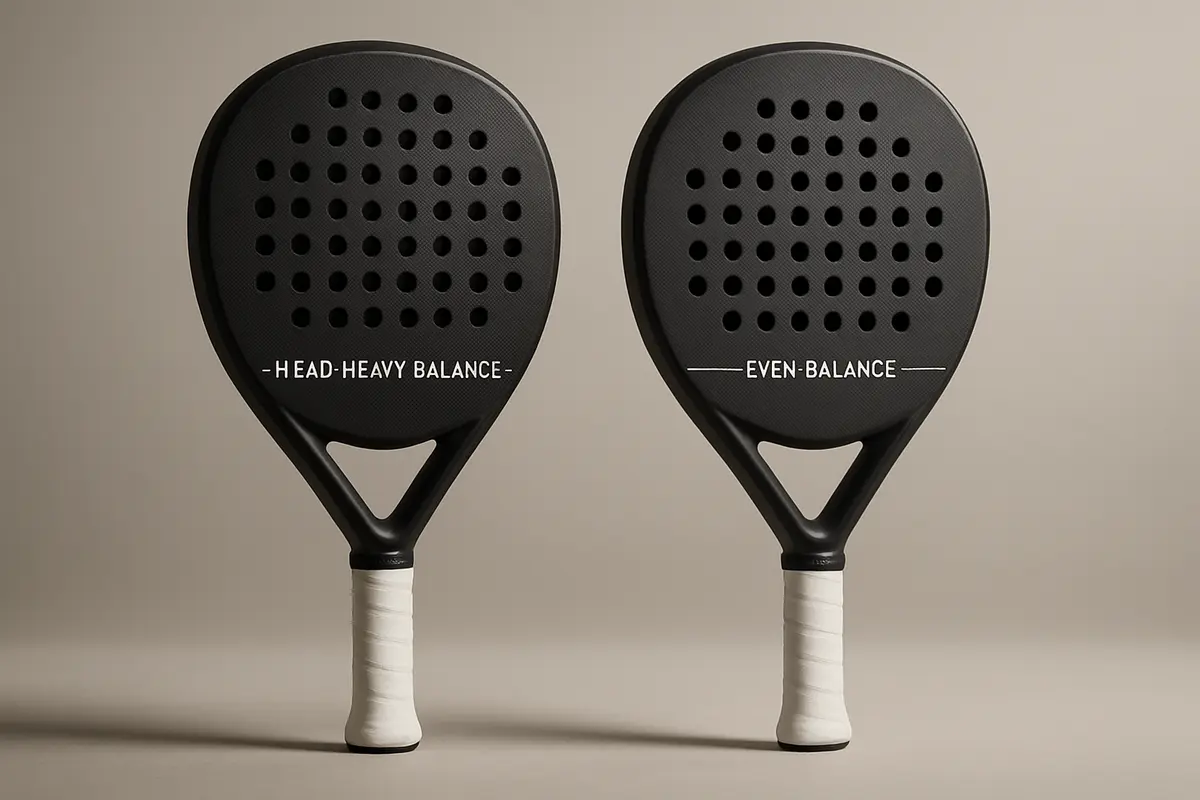
The three most common placements are the head, the handle and the throat. Adding weight at 3 and 9 o'clock (the sides of the head) increases the swing weight and the moment of inertia, which means the frame resists twisting on off-centre hits. The sweet spot effectively becomes more forgiving. Adding weight at 12 o'clock (the very top of the head) increases swing weight more aggressively and suits players who want more mass behind flat drives. Adding weight under the grip or in the handle lowers the balance point, making the frame feel more head-light and more manoeuvrable, at the cost of some plow-through.
The practical use case for pre-owned frames is this: a frame that plays at the right weight but feels unstable on wide balls often just needs 2 to 4 grams at 3 and 9. A frame that feels too head-heavy for volleys can be rebalanced with a small amount of weight under the grip. These are adjustments that cost under £5 and take five minutes to apply.
Go slowly. Add 2 grams, play a session, assess. Lead tape is easy to apply and easy to remove, but players who go straight to 8 grams often end up with a frame that swings completely differently from what they expected.
String savers: a genuine extension on string life#
String savers are small pieces of plastic or nylon that sit at the intersections of the main and cross strings, reducing the friction between them as they move during and after impact. That friction is the primary cause of string notching, which is what eventually causes polyester strings to snap at a crossing point.
If you play with a full polyester setup and you are breaking strings every three to four weeks, string savers are worth trying. They do not eliminate notching, but they can extend string life by 30 to 50 per cent. The trade-off is a slight change in feel: the string bed becomes a little stiffer because the strings cannot move as freely. For players who rely on spin from string snap-back, that is a real consideration.
String savers are most useful in the central 4 to 6 main strings where contact is most frequent. Covering every intersection is overkill and makes installation tedious. Focus on the middle of the string bed, and you get most of the benefit.
They are less useful with natural gut or multifilament strings, which are softer and tend to break from tension loss rather than notching. On those setups, the feel change is not worth it.
Which accessory does what: a quick reference#
| Accessory | What it physically changes | What it does not change | Best use case |
|---|---|---|---|
| Button dampener | String vibration frequency, sound, feel | Shock transmission to arm, power, spin | Players who want a quieter, more muted feel |
| Strip dampener | As above, more aggressively | As above | Players who find standard dampeners insufficient |
| Lead tape at 3&9 | Moment of inertia, stability on off-centre hits | Static weight significantly | Frames that feel unstable or twisty |
| Lead tape at 12 | Swing weight, plow-through | Manoeuvrability (reduces it) | Players wanting more mass on groundstrokes |
| Lead tape in handle | Balance point, feel of head-heaviness | Actual head weight | Frames that feel too head-heavy |
| String savers | Friction at string intersections, string life | Tension maintenance, feel significantly | Poly users breaking strings frequently |
Getting more from a frame you already own#
The real argument for all of this is that a pre-owned frame in good structural condition, set up thoughtfully, will outperform a brand-new frame that is wrong for you. I have seen players spend £200 on a new racket when £6 of lead tape would have solved the problem with the one they had.
If you have bought a pre-owned frame and it is not quite there, work through the variables in order. Start with string type and tension (the tennis string tension guide is the right place to start). Then try a dampener if feel is the issue. Then reach for lead tape if stability or balance is the issue. String savers come last, as a maintenance tool rather than a performance one.
If you are still looking for the right frame to start from, the pre-owned tennis rackets on the marketplace are listed with condition notes and specs. A frame that is 80 per cent of the way there, adjusted with accessories, is often better value than waiting for a perfect match at new prices.
And if you have gear sitting unused, listing it takes ten minutes and puts it in front of players who will actually use it. Good frames should not sit in a cupboard.