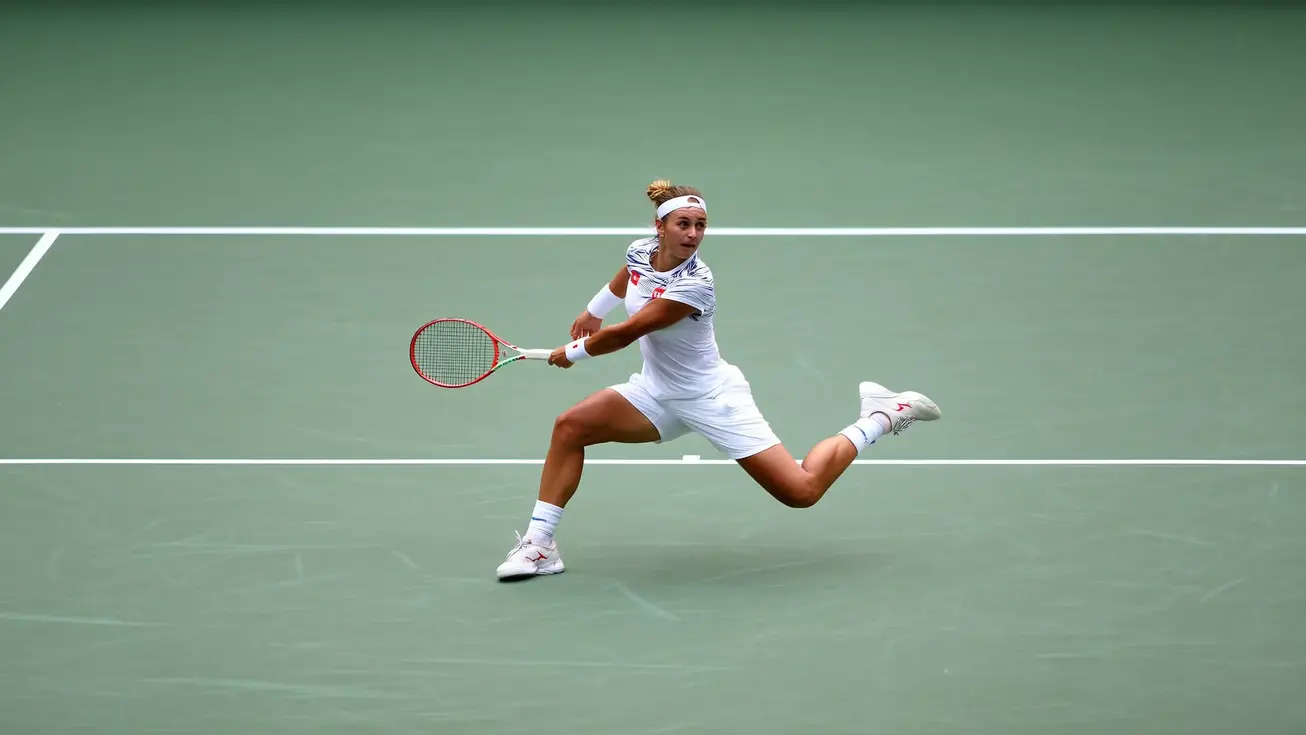
Most players who miss a ball late do not have a swing problem. They have a footwork problem that looks like a swing problem. The feet arrived a fraction too slow, the body was off-balance, and the arm tried to compensate. Fix the feet and a surprising number of technical issues quietly disappear.
That is worth sitting with for a moment. If you have been feeding money into lessons to correct your backhand and the coach keeps saying "get there earlier," the limiting factor is probably not your stroke mechanics at all. It is your movement pattern, and movement patterns are trainable on your own, without a hitting partner, without a ball machine, and without booking a court. A quiet corner of a car park, a strip of artificial grass, or an empty court on an off-peak morning is enough. What follows is a practical sequence I use myself and run through with players who want to get more out of their solo training time.
The split step: the one habit that changes everything#
The split step is a small hop timed so that you land just as your opponent makes contact with the ball. Landing in a slight squat with your weight on the balls of your feet means you are loaded and ready to push in any direction. Skipping it, or timing it wrong, means you are flat-footed for a fraction of a second, and that fraction is often the whole problem.
To train the timing alone, stand at the centre of the baseline and watch a video of a professional rally on your phone, propped against a ball can or a bag. Every time the player on the near side of the net strikes the ball, you split step. Do this for ten to fifteen minutes and you will feel the rhythm embed itself. The goal is not to think "split step now." The goal is for it to become reflexive, triggered by the visual cue of a racket swinging through contact. Once you can do it consistently watching video, take it onto the court and do it between the service line and the net post as you shadow-move to imaginary balls. The timing transfers faster than you expect.
Practise the split step as a response to a visual cue, not as a conscious decision.
Shadow swings with deliberate footwork patterns#
Shadow swinging is underrated because most players do it lazily. They stand more or less in one place, swing the frame, and call it done. The version that actually builds movement is this: start at the centre mark, split step, then move to a specific target position (forehand corner, net, backhand corner), set your feet properly, swing, and recover to the centre before the next repetition.
I run through a six-point pattern: wide forehand, short forehand, net forehand volley, net backhand volley, short backhand, wide backhand. Each rep is a full cycle: split, move, set, swing, recover. Thirty seconds on, fifteen seconds off, four rounds. By the third round your legs are working. By the fourth you are making the footwork decisions automatically because you are too tired to think through each one consciously, which is exactly the state you are in during a match.
Shadow swinging also fixes the recovery step. Most club players move well to the ball and then stand and watch where it went. Practising the recovery as part of every single shadow rep builds the habit of moving back to a neutral position the moment the swing is complete.
Shadow swinging only builds footwork if the recovery is part of every repetition.
The spider drill for explosive change of direction#
The spider drill is borrowed from basketball conditioning but it translates directly to tennis court coverage. Place five balls (or five markers if you want to keep the balls clean) at the following positions: centre mark, both singles sideline-baseline corners, and both T-junctions where the service line meets the singles sidelines. Start at the centre mark.
The drill: sprint to one marker, touch it, sprint back to the centre, touch it, sprint to the next marker, and so on until you have touched all five and returned to centre each time. Rest for sixty seconds and repeat. Three to five rounds is enough. Time yourself if you want a benchmark to beat across weeks.
What makes it specific to tennis is the deceleration. The court distances are short, which means you are accelerating hard and then braking and changing direction almost immediately. That deceleration, done with proper footwork (small adjustment steps as you approach the marker rather than a long lunge), is exactly what you need when you are chasing a drop shot or recovering from a wide ball. If your knees are taking a beating on this drill, it usually means you are arriving at the markers with straight legs. Bend into the stop.
The spider drill trains the deceleration and direction change, not just the sprint. Keep the adjustment steps short as you arrive at each marker.
Ladder work: coordination before speed#
An agility ladder costs very little and stores in a bag. If you do not have one, tape lines on a court or use the service box lines. The point of ladder work for tennis is not raw speed. It is foot coordination and the ability to place your feet precisely under pressure.
| Drill | Pattern | Tennis relevance |
|---|---|---|
| Two feet in each rung | Both feet land in every rung, one after the other | Basic lateral movement rhythm |
| Lateral shuffle | Side-step through the ladder, both feet in each rung | Baseline lateral recovery |
| Icky shuffle | In, in, out to one side, advance one rung, repeat | Split-step into wide forehand pattern |
| Crossover run | Cross the leading foot over and through each rung | Recovery from a wide ball |
| High knees forward | Alternate feet, one per rung, driving the knee up | Approach shot acceleration |
Run each pattern twice in each direction before moving to the next. The session takes about twelve minutes. Do it at the start of a solo court session as a warm-up and you will notice your footwork in the subsequent shadow swings is sharper, because the coordination is already switched on.
Use the ladder to warm up the movement patterns you are about to practise, not as a standalone conditioning session.
Putting it together in a solo session#
A practical order for a forty-five minute solo session: five minutes of ladder work to activate coordination, ten minutes of split step timing against video, fifteen minutes of shadow swings with the six-point pattern, and two rounds of the spider drill to finish. That is a complete footwork session with no partner, no coach, and no ball machine required.
If you are returning to tennis after time away and your gear needs a refresh before you start training again, it is worth browsing tennis rackets in the marketplace. Pre-owned frames in good condition are a sensible way to get back on court without overspending while you work out what you actually need. And if you are unsure what to look for when buying pre-owned, the post on how to spot a fake tennis racket covers the checks worth making before you commit.
Good footwork does not come from one session. It comes from doing these patterns often enough that they stop being drills and start being how you move. Twenty minutes three times a week will do more than an occasional hour-long session. Set a reminder, find your patch of court, and start with the split step.