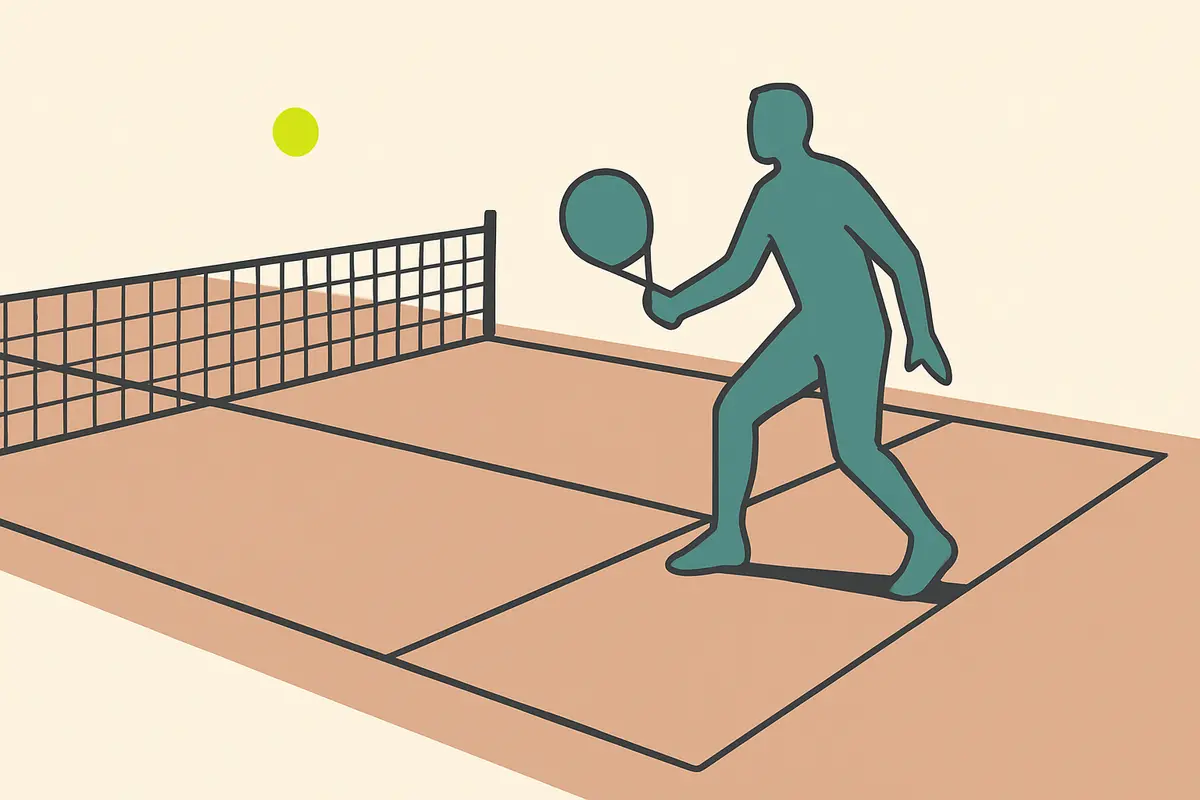
The single most common thing I see on padel courts is a pair standing in completely different time zones. One player is at the net, the other is hovering near the service line, and the middle of the court is open enough to park a car in. The opponents do not need to be clever. They just hit it there.
Positioning in padel is the foundation, not a finishing touch you add after you have sorted your technique. You can have a beautiful bandeja and still lose every point if you are standing in the wrong place. The good news is that the principles are simple, they are the same for every level, and once they click you will start reading matches completely differently, whether you are playing or watching through the glass.
The ready position: what it actually looks like#
When you are at the net, your feet should be roughly shoulder-width apart, weight slightly forward on the balls of your feet, knees soft. Your frame should be up in front of you, roughly chest height, not dangling at your side. This is not a rigid stance you hold for a photo. It is a state of readiness that lets you move in any direction in the next half-second.
The distance from the net matters more than most beginners realise. Too close (under a metre) and a hard drive at your feet becomes unplayable. Too far back (past the service line) and you are giving the opponents angles they should never get. The sweet spot is roughly one and a half to two metres from the net. That distance lets you volley comfortably, cover the lob with a step or two back, and still threaten the net.
One practical cue: your racket hand should be able to reach the net if you took a full stride forward. If you would need two strides, you are too deep.
Why you play at the net as a pair#
Padel is a net-dominant game. The pair at the net controls the point. This follows directly from geometry: a volley hit from two metres behind the net travels to the opponent in far less time than a groundstroke hit from the back wall. Less time means fewer options for the receiver. The net pair dictates pace, angle, and height. The back pair is defending and hoping for an error or a chance to come forward.
This is why the serve-and-approach pattern exists. You serve, you follow it in, and both you and your partner try to establish net position as quickly as possible. The opponents, meanwhile, are trying to do the same thing. Most of the interesting tactical chess in padel is about who earns the net and how long they can hold it.
If you are still playing from the back by choice, rather than because you have been pushed there, you are making the game harder for yourself. The exception is when you are genuinely out of position and need a reset shot off the back wall, which is a different conversation entirely.
Moving as a unit: the invisible rope#
Think of you and your partner as being connected by a short rope, roughly four metres long. When one of you moves left, the other moves left. When one of you goes back for a lob, the other drops back too. The shape of your pair should stay roughly constant relative to the ball.
This is the concept that separates tidy club players from chaotic ones. When the ball goes to your partner's side, your instinct might be to watch and stay still. The correct instinct is to slide across with them, maintaining your shared coverage of the court. You are not helping them hit the ball. You are ensuring that the reply, wherever it goes, finds one of you in a position to deal with it.
A simple drill for this: play a practice point where neither of you is allowed to be more than three metres apart from your partner at any moment. It feels restrictive at first. After ten minutes it starts to feel natural, and you will notice the court suddenly seems much smaller.
Covering the middle: whose ball is it?#
The middle of the court, the corridor running down the centre between the two players, is where most arguments happen and where most points are actually decided. The general rule is that the ball down the middle belongs to the player with the forehand in the centre. On a standard right-hander-plus-right-hander pair, that is the player on the left side of the court.
That rule breaks down when the ball is fast, when one player is out of position, or when one player is simply in a better spot. So the rule needs a layer on top of it: communicate. "Mine" or "yours" called early is worth more than any amount of tactical theory. The worst outcome is not one player taking the other's ball. The worst outcome is both players leaving it for each other.
Here is a quick reference for the decisions you will face most often at the net:
| Situation | Who takes it | Why |
|---|---|---|
| Ball through the middle, both players level | Player with forehand in centre | More natural swing path, reduces crossover |
| Ball to one side, partner clearly closer | Partner takes it | Proximity wins over convention |
| Lob over both players | Nearest player calls it and goes back | Other player holds net if possible |
| Fast drive at the body | Whoever it is aimed at | No time to negotiate |
| Short ball dropping at the net | Player in front of it | Do not wait for permission |
The table above is a starting point, not a rulebook. Every pair develops their own understanding over time. The pairs that talk during points, and between points, get there faster.
What to do now#
If you are new to padel and trying to get a feel for how the game fits together, the positioning principles here connect directly to the question of what gear actually suits a beginner. I wrote about that in choosing your first padel racket, and the short version is that a mid-range round or teardrop frame will let you focus on movement rather than fighting your gear.
If you are looking to get on court without spending full retail on a frame, there are solid pre-owned padel rackets listed on the marketplace right now at various price points. Positioning costs nothing to learn. The racket does not have to cost much either.
And if you are curious about how padel fitness compares to tennis, particularly if you are coming across from one sport to the other, padel vs tennis fitness covers the physical differences in a way that might change how you think about your court movement in both games.
Get the positioning right first. Everything else builds on top of it.